ESPR Performance Classes: The Ranking System That Makes Compliance Irrelevant to Competitiveness
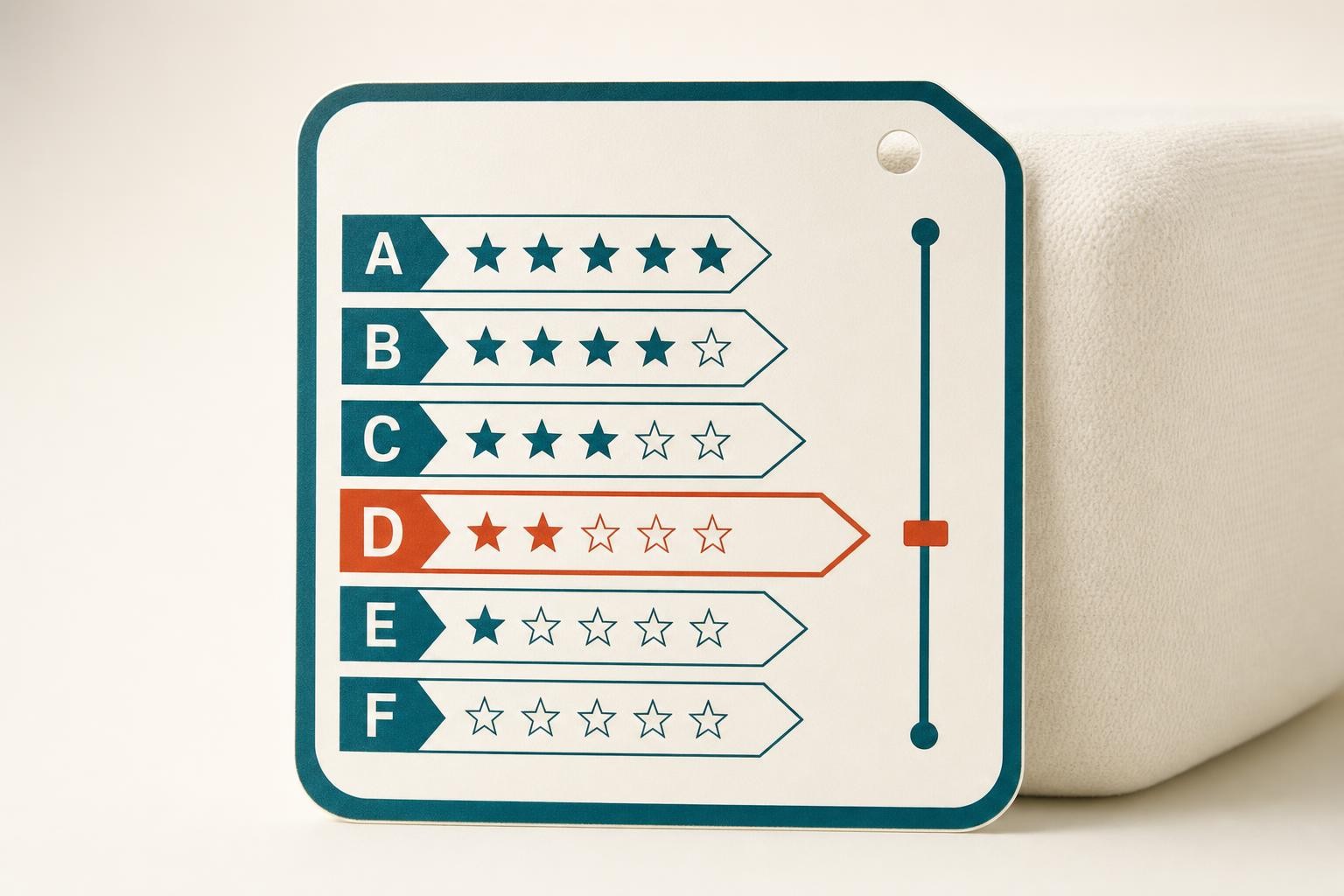
Most ESPR readiness programmes are built around a single question: will our product pass the threshold? That framing is understandable - a minimum requirement that removes non-compliant products from the market is the most immediate legal risk. But it misses a second instrument embedded in Regulation (EU) 2024/1781 that operates on an entirely different logic: classes of performance, displayed on an ESPR label, that rank every compliant product against every other compliant product in its category.
Passing the threshold gets you on the market. Your class tells buyers where you sit in it.
These are not the same question, and for most product groups the class definitions do not yet exist. That is precisely why now is the right time to understand the mechanism.
The Legal Basis: Article 16 and the Delegated Act Architecture
Regulation (EU) 2024/1781 is a framework regulation. The regulation establishes a framework of possible requirements, and the European Commission adopts delegated acts that specify which requirements apply to each product group, what the specific performance thresholds are, and when they take effect. ESPR itself sets no performance classes for any product. That work happens entirely in the delegated acts.
The label mechanism sits in Article 16 of the regulation. The recitals make the architecture explicit: where delegated acts include information requirements, they could, in addition, determine classes of performance in relation to one or more relevant product parameters, in order to facilitate comparison between products.
This creates a clean two-tier structure:
- A minimum performance requirement is a floor. Products that fall below it cannot be placed on the EU market. A product that clears the floor is fully compliant - the regulation has nothing more to say about it.
- A class of performance is a ranking. It sits above the floor. A product that clears the floor can still be placed in the lowest class on the label. It is lawful. It is also publicly graded at the bottom of its category.
ESPR itself sets no classes of performance for any product group. Classes are defined — if at all — in the product-specific delegated act. For most priority sectors, including textiles, electronics, aluminium and furniture, no delegated act has yet been adopted. Everything discussed here is indicative of the direction of travel, not fixed law.
The regulation also draws a clear boundary with the existing energy labelling framework. Regulation (EU) 2017/1369, which sets a framework on energy labelling, applies in parallel to this Regulation to energy-related products. Energy labels are a successful instrument as regards providing the appropriate information to consumers for energy-related products. Classes of performance determined under this Regulation should, where appropriate, be incorporated in the energy label as supplementary information. In other words: where the Energy Labelling Framework Regulation already governs a product, ESPR does not displace it - ESPR classes may instead feed into the existing energy label as supplementary data. The ESPR label is a new instrument for product groups that the energy label does not cover.
How Classes Are Being Defined: Two Competing Logics
The Commission's Joint Research Centre published its methodological groundwork in December 2025 (JRC143463). The objective of this report is to develop methods for defining classes of performance and the content of the future ESPR label. The report outlines a multi-step approach to select relevant product aspects and parameters appropriate for classes of performance, propose a method to develop classes of environmental performance based on the Product Environmental Footprint (PEF) single score and the single impact category, and develop classes of performance for circularity aspects/parameters.
That sentence contains a fork in the road that has significant commercial consequences.
Option 1: The PEF Single Score
The Product Environmental Footprint methodology aggregates impacts across multiple environmental categories - climate change, water use, land use, resource depletion and others - into a single weighted score. The JRC report refines the method for developing environmental performance classes based on the PEF score and single impact category, ensuring that products are categorised in a way that reflects significant improvements in environmental performance levels.
A single-score class is legible. One number, one class letter. But it compresses trade-offs: a product with excellent carbon performance and poor water use may score identically to one with the reverse profile. The class tells a buyer that two products are equivalent when they are not - they are just equivalent in aggregate.
Option 2: Per-Parameter Classes
The alternative is separate classes for individual impact categories or circularity parameters. Circularity aspects considered include durability, reliability, reusability, upgradability, repairability, maintenance, refurbishment, water use and efficiency, resource use and efficiency, recycled content, remanufacturing, recyclability, material recovery, and waste generation.
Per-parameter classes are more informative but harder to communicate. A product could be class A for recycled content and class D for repairability. That granularity is useful for a procurement officer running a specification; it is harder to render on a physical label.
The JRC report discusses the potential impacts of establishing classes of circularity and technical performances and the interaction of the ESPR label with other labels and the Digital Product Passport. It also proposes a typology of information to be included in ESPR labels, ensuring that the labels effectively communicate the environmental sustainability and circularity of products to consumers and other economic actors.
Why the choice matters commercially: A single-score class rewards balanced products and penalises specialists. A per-parameter class rewards excellence on specific dimensions and creates differentiation opportunities for products that lead on one axis. Your product roadmap should be tracking which approach the preparatory study for your sector is leaning toward - because the answer changes which investments pay off in class terms.
The Steel Case: What Classing Looks Like for an Industrial Intermediate
Steel is the first intermediate product to go through the ESPR preparatory process, and it is the most instructive live example of how performance classes work when the buyer is another business rather than a consumer.
This project is unique as it is the first intermediate product addressed within the ESPR framework. The study adopts a cradle-to-gate approach, analysing the environmental performance of iron and steel products from raw material extraction. The JRC proposes performance classes from A to E based on the cradle-to-gate carbon footprint for five representative products: hot-rolled coil, wire rod, galvanized cold-rolled coil, electrical sheet, and stainless steel. The method distinguishes between the BF-BOF and EAF routes, and between EU-produced and imported steel. For HRC produced in the EU via the BF-BOF route, emissions are estimated at approximately 1,813 kg CO₂eq/t; via EAF, it drops to 675 kg CO₂eq/t.
The stakes extend well beyond the label itself. The ESPR framework will materially affect EU industrial and climate policy, because the Industrial Accelerator Act proposal directly references the upcoming ESPR Delegated Act on steel for setting definitions for what is considered "low-carbon steel". A class earned under the ESPR delegated act could determine eligibility for green public procurement contracts and potentially for production quotas under industrial policy instruments.
Bellona, the environmental organisation that has tracked the steel preparatory study closely, has raised a pointed concern about calibration. The core problem is that the JRC calibrated Green Public Procurement thresholds so that Classes A+B capture 30% of global production volume. But on the EU market, virtually all production already qualifies. As currently designed, the classification risks legitimising the status quo instead of accelerating the transition to genuinely low-carbon steel.
That critique is a preview of a structural tension that will recur across every product group: if classes are calibrated to today's market distribution, the top classes are not a signal of leadership - they are a description of the median. By calibrating thresholds to today's market rather than breakthrough technologies, the system weakens incentives for first movers and risks undermining lead-market policies like green public procurement.
The steel case also illustrates the B2B dimension. For intermediate products, the label audience is not a consumer in a shop - it is a procurement officer at an automotive OEM or a construction contractor running a GPP-compliant tender. The commercial consequence of a low class is not a consumer choosing a competitor on a shelf; it is disqualification from a contract specification.
The Data Problem Gets Harder
A minimum performance requirement needs one defensible number: your product's measured value against the threshold. You need to know it once, verify it once, and document it once.
A class of performance needs something different. It needs a number that is comparable across competitors - which means the methodology, the system boundary, the allocation rules, and the verification standard all have to be consistent across the market. A carbon footprint calculated under one set of assumptions and a carbon footprint calculated under another are not comparable even if they produce similar numbers.
This is why the JRC's methodological work on classes is inseparable from the PCF and DPP data work that many teams are already running. The class you land in depends not just on your actual emissions or circularity performance, but on whether your measurement methodology aligns with the one the delegated act will mandate. A PCF calculated to a different system boundary than the one the class thresholds assume will produce a class assignment that is wrong - potentially in either direction.
Per-parameter circularity classes compound this. A recycled content class requires an auditable chain of custody. A repairability class requires a standardised scoring protocol. These are not numbers that exist in most product data systems today.
The practical implication: treat the methodology question as the first data question, not the last. Before you calculate where your product would land, confirm which methodology the preparatory study for your sector is proposing to use. Running a shadow calculation against the wrong methodology produces a misleading result.
The Moving Target: Classes Erode as Competitors Improve
There is a structural feature of relative ranking systems that compliance teams tend to underweight: a class earned today can be lost without any change to your product.
If classes are calibrated to the market distribution at the time the delegated act is adopted, and competitors subsequently improve their products, the distribution shifts. A future rescaling - or a delegated act revision - can move the class boundaries. A product that was class B becomes class C without changing a single manufacturing parameter.
The energy label rescaling of 2021 is the reference case. A product showing an A+++ energy efficiency class may, for example, become a D or E class after rescaling, without any significant change in its energy consumption. The old energy label had been affected by an overpopulation of the top classes, while the bottom ones were empty. To address this, the new energy criteria for each of the classes were been set much stricter than before, and the top energy classes were deliberately left empty to allow differentiation of more energy efficient models that will be produced in the future. As a result, the energy class of all products on the market was downgraded.
Once the top energy classes fill up again - specifically, once more than 20% of the appliances in a given category achieve energy class A - a new rescaling will be undertaken.
The ESPR regulation does not yet specify a rescaling trigger equivalent to the energy label's 20% rule. But the logic is the same: classes are a relative instrument. A market that improves collectively will eventually require the scale to move. The implication for product roadmaps is that maintaining a class requires tracking competitor trajectories, not just your own performance.
What to Do Now
Class definitions are not yet adopted for most product groups. That is not a reason to wait - it is a reason to act while the methodology is still being shaped.
Check the preparatory study for your product group on the JRC Product Bureau. If a preparatory study is underway, look for whether performance classes and a label are in scope. For steel and aluminium, they are. For textiles, the third milestone study is published. For electronics and furniture, preparatory work is at an earlier stage.
Determine whether the study is proposing a PEF single-score approach, a per-parameter approach, or both. This determines which data you need to collect and which system boundary applies. For steel, it is cradle-to-gate PCF. For textiles, the JRC has explored both PEF single-score and carbon-footprint-only options.
Using the draft class thresholds from the preparatory study (where published), calculate where your product would currently land. Treat this as a directional indicator, not a final answer — thresholds will change before adoption. For steel, the JRC's draft A-to-E scale based on cradle-to-gate CO₂eq/t gives a workable starting point.
If your shadow calculation puts you in the bottom half of the class distribution, that is a product development signal, not just a compliance gap. The question is not 'how do we avoid the worst class?' but 'what class do we need to be in to remain competitive in GPP tenders and B2B procurement in three years?'
Set up monitoring for delegated act consultations in your sector. Class thresholds are still being negotiated. Stakeholder consultation is the point at which industry input can influence where the class boundaries land — and the Bellona steel case shows that the calibration choices made at this stage have material consequences for who benefits from the top classes.
The Competitive Reframe
The binary framing - will my product pass? - is a compliance question. It has a binary answer. Classes of performance convert that binary into a spectrum, and they make that spectrum visible to every buyer in the market.
A product that clears the minimum requirement is lawful. A product in the top class is lawful and publicly ranked as a market leader. A product in the bottom class is lawful and publicly ranked as a laggard. The regulation does not remove the laggard from the market. It just tells everyone where it sits.
For product managers and sustainability leads in steel, aluminium, textiles and electronics, the practical implication is this: the compliance question and the competitiveness question have separated. Answering the first no longer answers the second. The data work, the methodology alignment, and the product investment decisions that determine your class are distinct from - and in most cases more demanding than - the work required to clear the minimum threshold.
That distinction is worth building into your ESPR programme now, before the delegated acts land and the class definitions become fixed.
Related reading
Who Sees What in a Digital Product Passport: Access Rights, Customs and Confidential Business Data
A passport is not a public web page. ESPR gives consumers, repairers, recyclers, authorities and customs different views of the data. Here is how role-based access works, what the pending security standards add, and how to protect trade secrets.
The ESPR Textiles Delegated Act: What the Draft Is Expected to Require from Apparel Brands
The textiles delegated act is the next big ESPR measure for fashion. Here is what the JRC preparatory work points to on durability, recyclability of mixed fibres and data points, the likely timeline, and how brands should prepare now.
The EU Digital Product Passport Registry Is Live: How Economic Operators Actually Register
The Commission's DPP Registry is operational. Here is the two-stage registration process, why a qualified electronic seal matters, who carries the obligation in the supply chain, and what to do before the first hard deadline in February 2027.